Cottongrass (Eriophorum, cottonsedge)
The amazing world of trees, plants and flowers in quality pictures..................................................................... - click on images to see in large -
Friday, November 9, 2012
Monday, October 22, 2012
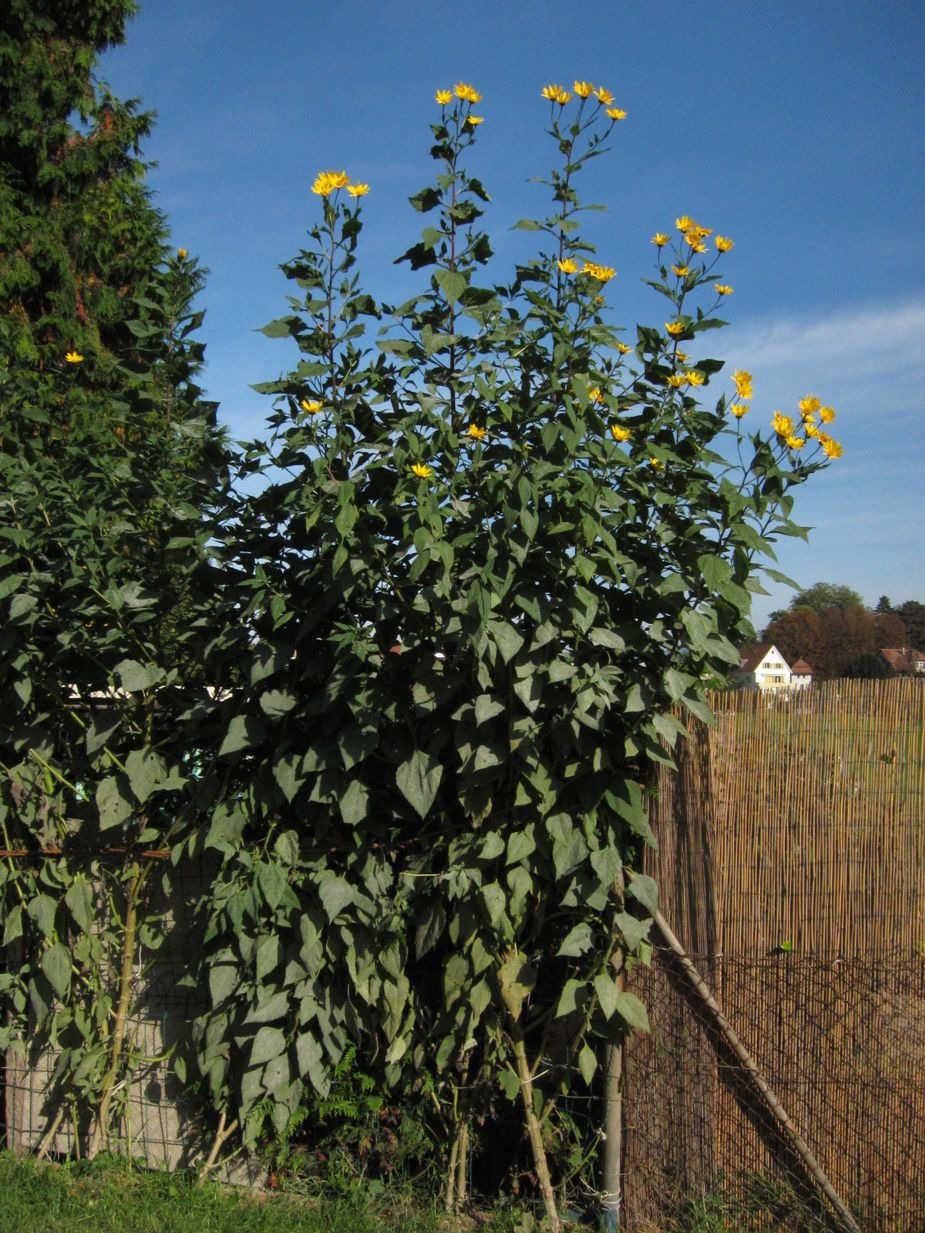
Heliantus tuberosus (sunchoke, sunroot, earth apple, topinambour, Jerusalem artichoke, indian potato) - young plant flowering in October in Switzerland
The plant is native to North America and was first cultivated by Native Americans for its tuber which was used as a root vegetable long before the arrival of Europeans. Italian settlers in USA called the plant girasole, the Italian word for sunflower, because of its resemblance to the garden sunflower. Over time the name girasole may have changed to Jerusalem. To avoid confusion, the plant is called now sunchoke or sunroot. The artichoke part of the name comes from the name of its edible root. Samuel de Champlain, the French explorer, sent the first samples of the plant to France, noting its taste was similar to an artichoke.
The tuber of the sunchoke, instead of containing starch like potato, has the allied substance Inulin (not to confuse with insulin), which might be a digestive problem in food as it might produce flatulance in some people. On the other hand, it is better for diabetics than the common potato because the carbohydrates and sugars can be assimilated by the digestive tract without insulin.
In Baden-Württemberg, Germany, over 90 % of the sunchoke root is used to produce a spirit called Topinambur, Topi or Rossier.
Sunday, October 14, 2012
Ptilotus exaltatus (Pink Mulla Mulla, Joey, Lamb's Tail, Pussy Tails, Haarschöpfchen) - potted plant flowering in July in Europe
The plant is native to western and central Australia. Its name means 'tall feathers'. There are around 100 species in the genus Ptilotus, all but one occuring in Australia. They are occuring in habitats from tropical areas to the arid inland. They are usually herbaceous (relating to or characteristic of an herb as distinguished from a woody plant) perennials.
The conical flower heads with lengths of 15 cm and diameters of 5 cm resemble bottle brushes with hairy pink-purple blooms and they have a little tilt at the top that hints at a feather. The egg-shaped to oblong leaves grow 4 to 12 cm long.
Cultivated in gardens they bring a lot of color in dry, hot spots with full sunshine. There is considerable research being undertaken into the cultivation requirements of this genus because of their potential as cut flowers.
reference is made to: The Australian Native Plants Society (Australia)
Tuesday, October 2, 2012
Sunday, September 30, 2012
Thursday, September 27, 2012
Epilobium angustifolium (fireweed, willow herb, rosebay willow herb, French willow, great willowherb, Schmalblättriges Weidenröschen)
The plant is native throughout the temperate Northern Hemisphere. As a pioneer plant it grows in new open areas which may be generated after deforestations, fire and human intervening. Fireweed gets its name from the fact that it is often the first plant to start growing in forests after fires burn back all other vegetation. Fireweed was one of the first and most abundant colonizers of Mt. Saint Helens after it erupted.
The plant reaches a height of 1 to 2 meters and flowers in July-August partly creating a delightful flowering ocean of brilliant purple in open, cleared landscapes and along roadsides. Plants grow and flower as long as there is open space and plenty of light, as trees and brush grow larger the plants die out, but the seeds remain viable in the soil seed bank for many years, when a new fire or disturbance occurs that opens up the ground to light again the seeds germinate.
Leaves and young shoot tips of fireweed are edible, raw or cooked. Very young leaves are used for salads and soups or steeped for use as a tonic tea for upset stomach. Mature leaves become tough and bitter and may cause nausea. The unopened flowerbuds are tasty for salads or in stir-fries.
Fireweed has long been used as medicine and the herb is antispasmodic, hypnotic, laxative and tonic, and has agents that cause the tissue to contract (remedy against prostate enlargement) and that soften and sooth the skin when applied locally. A fiber obtained from the outer stems can be used to make cordage. The cottony seed hairs which serve for wind dispersal over long distances has been used as a stuffing material or as tinder.
Uses of Epilobium angustifolium 1 (YouTube video)
Uses of Epilobium angustifolium 2 (YouTube video)
Wednesday, September 26, 2012
Ceiba speciosa (formerly Chorisia speciosa, silk floss tree, toborochi tree, drunken tree) - Aspire Park in Doha, Qatar - photography by terp16 on Panoramio
The silk floss tree belongs to the same family as baobab and the kapok and is native to tropical and subtropical forests of South America. Its trunk is bottle-shaped, generally bulging in its lower third, measuring up to 2 meters in girth. The tree is also well known for the large spikes protecting the trunk and the limbs, however the spikes are prominent when the tree is young.
The silk floss tree is rated among the most beautiful trees in the world due to its spectacular blooming with thousands of flowers in pink, white and purple. The tree is resistant to drought and moderate cold. It is cultivated for ornamental purposes. Outside gardens around the world, it is often planted along urban streets in subtropical areas such as in South Africa, Australia, northern New Zealand and southern USA.
Tuesday, September 25, 2012
Rumex acetosella (Acetosella vulgaris, sheep sorrel, red sorrel, sour weed, Sauerampfer) - Baltic Sea coast in Germany
This perennial weed is native to Eurasia but have spread over the rest of the northern hemisphere. It favors moist soil, so it thrives in floodplains and near marshes. It is often one of the first species to take hold in disturbed areas, such as abandoned mining sites, especially if the soil is acidic.
There are several uses of sheep sorrel in the preparation of food including a garnish, a tart flavoring agent, a salad green, and a curdling agent for cheese. The leaves have a lemony, tangy and nicely tart flavor. Sheep sorrel taken as a cool drink may reduce a fever. As a tea it is good for diarrhea, a gargle for soar throats.
Sunday, September 23, 2012
Medinilla magnificia (Pink lantern, Rose grape, Malaysian orchid)
This tropical shrub native to Philippines bears drooping clusters of rosy pink flowers. It is one of the most elegant plants which can be grown indoors, but needs high humidity. It grows up to 8 feet tall in its natural habitat in part shade locations out of soil pockets on rain forest trees or in ground clearings with large, ovate to oblong, prominently veined, leathery green leaves to 8 - 12 inch long.
Friday, September 21, 2012
Taxodium distichum Rich (Baldcypress, Sumpfzypresse) - The Botanical Garden of the University of Basel
The baldcypress is a deciduous conifer native to the Southeast of the United States. The tree with a reddish brown trunk and a feathery foliage is generally found in wet swampy areas, often in standing water. It grows slowly and may reach heights of 25 - 40 m and trunk diameters of 2 - 5 meters. Ancient baldcypress forests with some trees more than 1,700 years old, once dominated swamps in the southeast US. The wood of the tree is known for its resistance to water and decay and is used for heavy construction, including docs, warehouses, boats, bridges, and interior trim. In colder climates, the trees are planted as ornamentals.
Sunday, September 16, 2012
Verbascum olympicum (Greek mullein, Olympian mullein, Königskerze (German))
The plant grows 2 to 3 meters tall and bears an enormous candelabra of golden flowering spikes, easily up to 90 cm high. It takes two to three years for the plant to flower, usually it dies afterwards. However, they do self-seed copiously and, if possible, leave seedlings where they appear naturally as they are very drought-tolerant. The perfect dramatic plant for easy gardening as verbascums are not fussy about soil and water and are also snail proof.
Verbascum olympicum is native to the ancient Mt. Olympus in Turkey (now known as Uludag). Uludag is the most western extension of the Pontic mountains range. It is one of the highest peaks in the area and is rich in biological diversity, including an astonishing 104 endemic species of plants.
Friday, September 14, 2012
Stachys byzantina (Lamb's Ears, Woolly Betony, synonyms: Stachys lanata, Stachys olympics)
Ground-covering perennial, popular for its soft, fluffy foliage, native to Turkey, Armenia and Iran. They are named Lamb's Ears because of the curved shape and white, soft, fur-like hair coating. The plant is cultivated over much of the temperate world as an ornamental plant, and is naturalized in some locations as an escape from gardens. The extract of it has shown antimicrobial activity against Staphylococcus aureus that is resistant to vancomycin.
Tuesday, July 24, 2012
Zantadeschia (Calla Lily, Calla, Arum Lily)
Flowering plant in the family Araceae originating from southern Africa and named after the Italian botanist Giovanni Zantedeschia (1773-1846). The plant is despite its names neither a true lily, nor arum or calla. The flowers can be seen in many paintings. The Zantadeschia species are poisonous.
Monday, July 23, 2012
Weeping Willow tree (Salix babylonica, Babylon Willow, Peking Willow) - Riehen, Switzerland
Salix babylonica is a popular ornamental tree, and it was described and named by the famous Swedish botanist Carl Linnaeus in 1736. Linnaeus believed by mistake that the tree described in the Bible in the opening of Psalm 137 was a weeping willow and gave three the name babylonica, although the tree originates from northern China.
Saturday, July 21, 2012
Meadowsweet (Filipendula ulmaria)
Common plant in Europe and western Asia along the banks of rivers and lakes and in damp meadows. The delicate, graceful, creamy-white flowers cluster close together in handsome irregularly-branched cymes, having a very strong. sweet smell. They flower from June to early September.
Friday, July 20, 2012
Nepenthes maxima x ventricosa (pitcher plant, monkey cup)
Nepenthes are a family of carnivorous plants comprising roughly 140 species (including the cultivated hybrids). Most of the species use a pitfall trap with slippery inner walls and a fluid reservoir on the bottom containing viscoelastic biopolymers which prevent the captured prey to escape. The lid of the pitcher prevents the liquid to dilute with rain. The lower part of the trap contains glands which absorb nutrients from captured prey. Some other nepenthes species use equipment like flypaper traps to catch the prey.
Thursday, July 19, 2012
Female (the shorter ones on the left) and male alder catkins on the same plant - photography by nondesigner99
Wednesday, July 18, 2012
Alder trees lined up along a small brook - Riehen, Switzerland
Alder is the most common tree in riparian forests, and it improves soil fertility through the ability to fix nitrogen from the air due to a symbiotic friendship of alder with a nitrogen-fixing bacterium. This bacterium is found in root nodules, which may be as large as a human fist, with many lobes and light brown in appearance. The bacterium absorbs nitrogen from the air and makes it available for the tree. Alder, in turn, provides the bacterium with sugars. As a result of this mutually-beneficial friendship, alder improves the fertility of the soils where it grows.
Tuesday, July 17, 2012
Monday, July 16, 2012
Gold Yarrow (Achillea filipendulina) - Goldgarbe, gelbe Schafsgarbe
The genus Achillea - the common name yarrow is normally applied Achillea millefolium with white flowers, but may also be used for other species within the genus - has a long history as a powerful healing herb used topically for wounds, cuts and abrasions. The plant family is named for the Greek mythological character Achilles who reportedly carried it with his army to treat battle wounds. Navajo Indians considered it to be a 'life-medicine', chewed it for toothaches, and poured an infusion into ears for earaches. Several cavity-nesting birds use yarrow to line their nests because adding yarrow to nests inhibits the growth of parasites. Yarrow is considered as an especially useful companion plant, not only repelling some bad insects while attracting good, but also improving soil quality. It is considered directly beneficial to other plants, improving the health of sick plants when grown near them.
Yarrow has also been used as food, and was very popular as a vegetable in the seventeenth century. The younger leaves are said to be a pleasant leaf vegetable when cooked as spinach, or in a soup. Yarrow is sweet with slight bitter taste. The leaves can also be dried and used as a herb in cooking.
Even the Neandertal people medicated themselves by eating yarrow, as has been found out these days.
Sunday, July 15, 2012
Common Foxglove (Digitalis purpurea)
The scientific name digitalis means 'finger-like' and refers to the ease with which a flower of the foxglove can be fitted over a human fingertip. The flowers vary with species from purple to pink, white and yellow, but the common foxglove is the best-known digitalis. The entire plant including the roots and seeds is toxic and this resulted in sinister names for the plant like Dead Man's Bells or Witches' Gloves. The extract of digitalis is used to treat heart conditions in the medicine.
Friday, July 13, 2012
Monday, July 9, 2012
Green almonds (Prunus dulcis)
The young, developing fruit of the almond tree can be eaten whole (green almonds) when they are still green and fleshy on the outside and the inner shell has not yet hardened. The fruit is somewhat sour, but it's a popular snack in the parts of Middle East, eaten dipped in salt to balance the sour taste. Available only from mid April to mid June (northern hemisphere) pickling or brining extends the fruit's shelf life.
Sunday, July 8, 2012
Horse-chestnut trees - Riehen, Switzerland
Horse-chestnut (Aesculus hippocastanum, Conker tree) derives its name from the erroneous belief that the tree was a kind of chestnut, together with the observation that eating them cured horses of chest complaints despite this plant being poisonous to horses. The processed and refined extract of horse-chestnut is used to cure varicose veins in legs and hemorrhoids.
Subscribe to:
Posts (Atom)